The persistent objection to heat pumps in cold parts of the country sounds like this: "they don't work below freezing." That belief was substantially correct fifteen years ago and is substantially wrong today. The technology that's now sold under the "cold-climate heat pump" (CCHP) label is a different machine than the heat pump your contractor remembers from the early 2000s. Real-world field data from cold-climate installs in Maine, Vermont, Minnesota, and Manitoba shows modern CCHPs maintain useful heating capacity well below 0°F. This article unpacks what "cold-climate certified" actually means, how capacity changes with outdoor temperature in practice, and what to look for when sizing a system for a cold home.
What "cold-climate certified" actually means
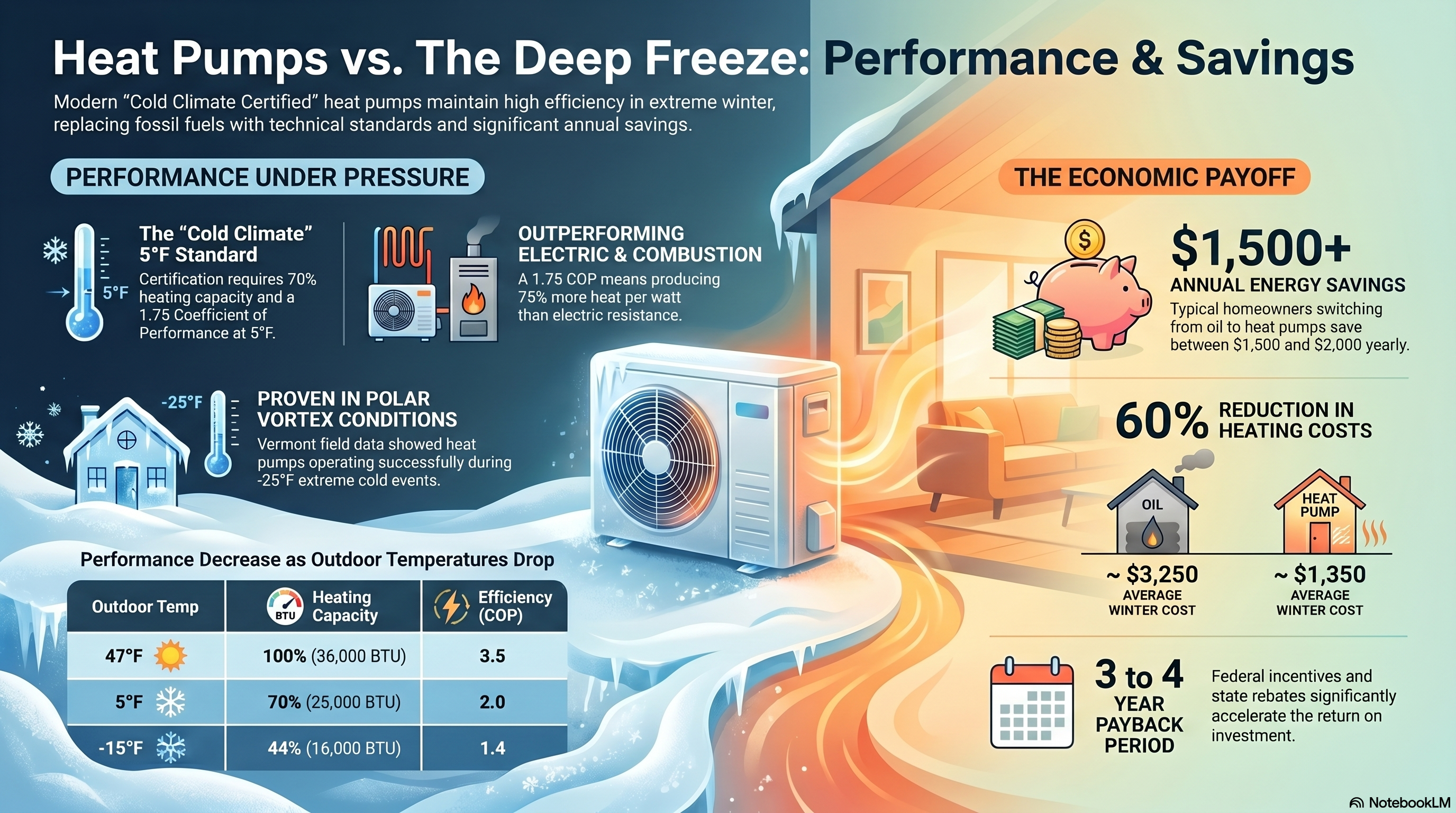
The ENERGY STAR Cold Climate Heat Pump certification is the U.S. industry's technical definition. To qualify, a heat pump must produce at least 70% of its rated heating capacity at 5°F outdoor temperature, and have a coefficient of performance (COP) of at least 1.75 at 5°F. COP is the ratio of heat output to electrical input — a COP of 1.75 means every watt of electricity produces 1.75 watts of heat (or stated differently, the heat pump is 175% efficient at 5°F).
Two things are worth noting about that definition. First, 5°F is colder than most U.S. winters experience. Boston's coldest design temperature is roughly 9°F. Minneapolis is around -5°F. The certification ensures the heat pump performs well at the threshold most cold-climate U.S. homes need. Second, COP 1.75 is still substantially better than electric resistance heat (COP 1.0) or any combustion-based heating system once you account for fuel-to-heat conversion losses.
The certification list (search "ENERGY STAR Cold Climate Heat Pump certified products" for the current list) covers all major manufacturers. Mitsubishi Hyper-Heat (H2i), Daikin Aurora, Bosch IDS, LG inverter cold-climate units, and Carrier Greenspeed all qualify. Most state rebate programs and federal HEEHRA require this certification (or its equivalent) for the heat pump to be eligible — non-cold-climate units sold for installation in zone 4+ won't collect any of the major incentives.
What the capacity curve actually looks like
A heat pump's heating capacity drops as outdoor temperature drops, because there's less heat in cold outdoor air to extract. The curve is roughly linear from 47°F (the AHRI rating point) down to about 5°F, then steepens. A typical 3-ton (36,000 BTU/hr) cold-climate unit produces:
At 47°F outdoors: 36,000 BTU/hr (100% of rated capacity, COP ~3.5).
At 17°F outdoors: 28,000 BTU/hr (78%, COP ~2.4).
At 5°F outdoors: 25,000 BTU/hr (70%, COP ~2.0).
At -5°F outdoors: 20,000 BTU/hr (56%, COP ~1.7).
At -15°F outdoors: 16,000 BTU/hr (44%, COP ~1.4).
At -25°F outdoors: many units cut out entirely or run at 25–30% capacity with COP near 1.0.
Two things follow from this curve. First, sizing matters: if your heating load at design temperature requires 30,000 BTU/hr and your heat pump only produces 25,000 BTU/hr at that temperature, you have a 5,000 BTU/hr deficit that has to be covered somehow — either by oversizing the heat pump, by running the system harder at higher daily runtime, or by supplemental heat. Second, the worst-performance hours are rare in most U.S. cold-climate cities. Boston experiences temperatures below 5°F roughly 70 hours per year on average. Minneapolis sees them about 350 hours per year. The remaining 8,000+ hours of the heating season operate at substantially better COPs.
Field performance data
Several independent studies have measured CCHP performance in cold-climate U.S. homes over multi-year periods. The most cited is the Cold Climate Air Source Heat Pump (CCASHP) field study run by the Center for Energy and Environment in Minnesota. Across hundreds of installs in Minnesota homes (climate zone 6 and 7), CCHPs delivered seasonal COPs of 2.2 to 3.0 across full winters, including stretches with multiple days below -10°F. Homes with adequate insulation and properly sized equipment did not need supplemental heat for the vast majority of winter hours.
The Efficiency Maine field study (over a thousand installs across the state) found similar results: average seasonal COPs of 2.5–3.0 in homes that previously used oil heat. Reported homeowner satisfaction was high — over 90% said they would install the heat pump again. The most common complaint wasn't comfort or capacity, it was learning how to operate the system efficiently (which we'll come back to).
Vermont's Cold Climate Heat Pump program tracked 200+ installs across multiple winters, including the polar vortex events of 2024 with temperatures hitting -25°F in some areas. Heat pumps continued operating at most installations, though many homes activated supplemental heat (typically electric resistance backup or, for hybrid setups, the existing oil furnace) for the coldest 24–48 hour periods. In cost terms, the supplemental heat ran for less than 5% of the winter at most homes — the heat pump did 95%+ of the work.
Sizing for a cold climate
Three sizing approaches dominate cold-climate installs, each with different cost and reliability tradeoffs.
Sized for design temperature. Pick a heat pump whose capacity at your county's 99% design temperature meets or exceeds your home's heat loss at that temperature. This eliminates supplemental heat entirely. It's the most expensive option upfront because it usually requires going one size larger than a non-cold-climate sizing would suggest, and it can lead to short-cycling on milder days if the heat pump can't modulate down enough.
Sized for 17°F balance point. Pick a heat pump that meets your heating load at 17°F outdoor temperature, and use supplemental heat (electric resistance strips inside the air handler, or an existing fossil-fuel furnace) for colder hours. This is the most common approach. The supplemental heat runs for the coldest 50–200 hours per year, which represents 1–4% of total winter heating in most U.S. cold climates. Energy cost impact is small — but the supplemental heat must actually exist, so the air handler needs the strip heat option or you keep your old furnace as backup (a "hybrid" configuration).
Hybrid (dual fuel). Keep the existing fossil-fuel furnace, install a heat pump alongside it, and switch between them based on outdoor temperature. The heat pump runs whenever it's economically favorable (typically above 25–35°F depending on local fuel prices); the furnace takes over below that threshold. This minimizes electric resistance backup and uses the existing furnace as a known-good worst-case fallback. Most install-cost calculations show hybrid is cheaper to operate than pure heat pump in regions with very cheap natural gas or with electricity rates above $0.25/kWh.
What to look for in a cold-climate quote
When collecting quotes from contractors for a cold-climate install, four things separate good quotes from bad ones.
Manual J load calculation. A proper sizing calculation (Manual J methodology) considers your home's square footage, insulation levels, window types, air sealing, and orientation. Contractors who size by "rule of thumb" (e.g., one ton per 500 square feet) routinely oversize by 20–40%, which causes short-cycling, comfort problems, and capacity matching issues at low temperatures. Ask for the Manual J printout. If they can't produce one, get a different quote.
Capacity-at-temperature spec sheet. The manufacturer publishes a capacity table for the specific model showing BTU output and COP at multiple outdoor temperatures (47°F, 17°F, 5°F, often -5°F and below). Your contractor should provide this. Compare your home's heat loss at design temperature to the unit's output at design temperature — if the unit produces less than your load, you're committing to supplemental heat for the coldest hours, and you need to decide if that's acceptable.
ENERGY STAR Cold Climate certification on the AHRI certificate. The AHRI certificate is the matching paper that proves your specific outdoor unit + indoor unit combination achieves the rated performance. Verify the certificate explicitly notes "Cold Climate" certification. Some contractors quote a cold-climate-rated outdoor unit paired with an indoor unit that pulls the certification out of compliance — without the AHRI matching certificate, you'll lose access to most rebates.
Defrost cycle handling. All heat pumps periodically reverse to defrost the outdoor coil. During defrost (5–10 minutes every 30–90 minutes in cold/humid weather), the unit blows cool air into the home unless it has electric strip backup that activates during defrost. Quality cold-climate installs include strip heat sized to maintain comfort during defrost cycles. Ask explicitly about defrost handling — it's a comfort issue that's easy to overlook in pre-install conversations.
Operating tips for cold-climate homeowners
The number one cause of homeowner dissatisfaction in cold-climate field studies wasn't equipment failure — it was operating habits carried over from gas furnace experience. Heat pumps are most efficient running long, steady cycles at modest output. They are least efficient when forced to make a big temperature swing quickly. The setback strategy that works for gas (drop temperature 10°F overnight, recover in the morning) is exactly wrong for heat pumps: the morning recovery often kicks in expensive electric resistance backup, wiping out the efficiency advantage.
The best practice for heat pump operation is "set it and forget it" — pick a comfortable temperature and leave it there. Modern variable-speed units modulate output continuously and run at high efficiency when allowed to. If the home is unoccupied for multi-day periods (vacations, second homes), a 5–8°F setback is fine, but daily setbacks generally aren't worth the efficiency loss.
Filter changes matter more than with gas systems. Heat pump airflow is more sensitive to restriction; a clogged filter drops capacity and increases run time. Plan to check the filter monthly and replace every two to three months in winter.
Where it pays off most
The economics of cold-climate heat pumps are strongest where the alternative is electric resistance, oil, or propane. A typical Maine home heating with oil at $4.50/gallon spends $3,000–$3,500 per winter. A cold-climate heat pump in the same home runs $1,200–$1,500 per winter — savings of $1,500–$2,000 per year, before any rebate. With Efficiency Maine's rebates ($4,000+) — and HEEHRA on top for income-qualified households where Maine's funding is still open — the payback period is often three to four years. Note: the federal §25C heat pump tax credit was repealed for installs after Dec. 31, 2025 and is no longer part of the math.
For homes already on cheap natural gas, the operating cost case is weaker, and a hybrid (dual fuel) install is often the better economic choice. See heat pump costs in Boston for an example of how the math works in a cold, gas-served metro with strong state rebates, and Denver heat pump costs for a high-altitude cold climate with utility rebate stacking.
For brand-by-brand comparison of cold-climate-certified models — Mitsubishi Hyper-Heat, Daikin Aurora, Bosch IDS, LG, Carrier Greenspeed — see our heat pump brands page. For a deep dive on which rebates apply in your state, see the state rebate index.