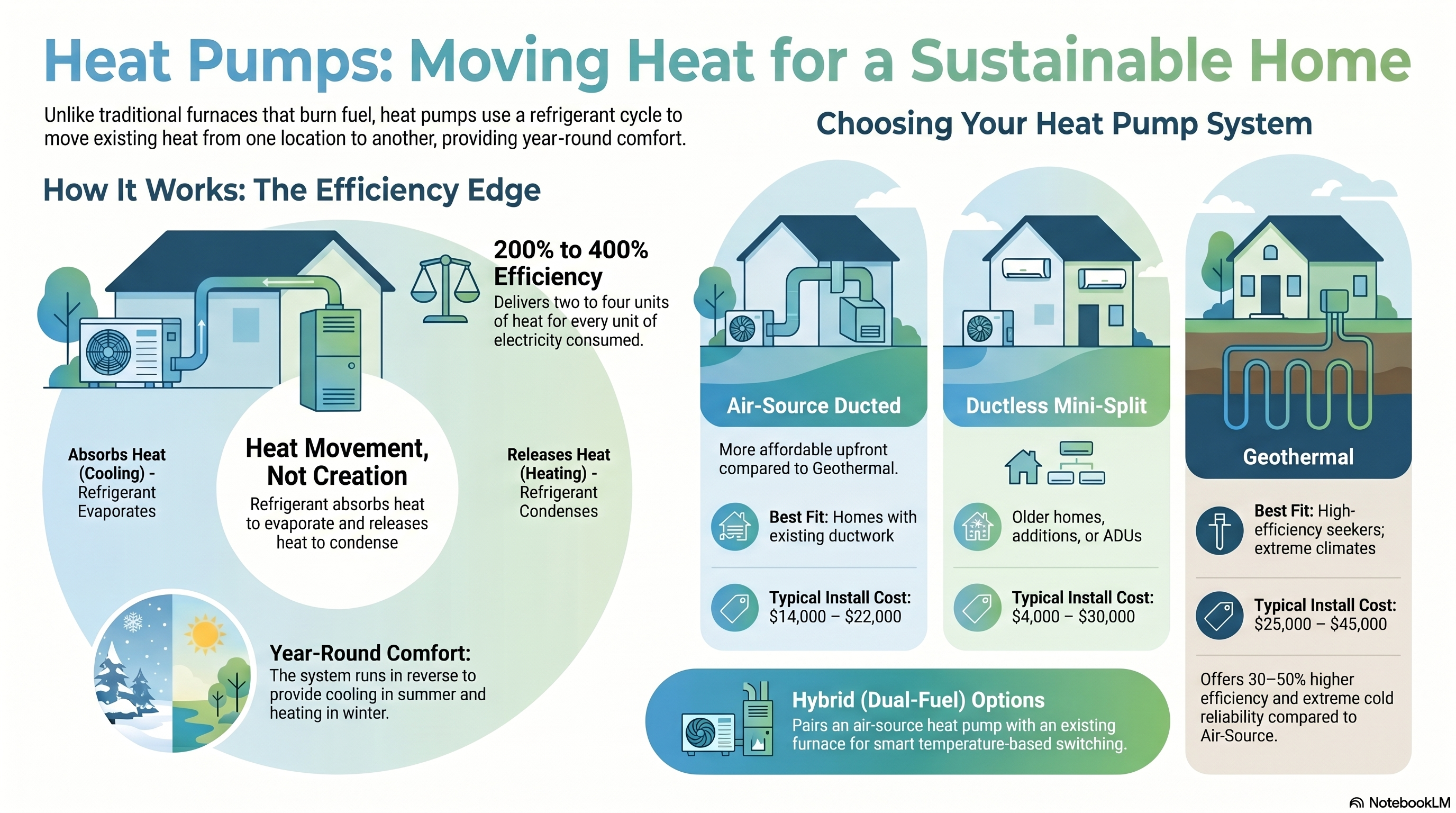
The single sentence that explains a heat pump is this: it doesn't make heat, it moves heat. A furnace burns fuel to create warmth. A heat pump runs a refrigerant loop that extracts heat from one place and releases it in another — and because moving heat takes far less energy than creating it, a heat pump typically delivers two to four units of heat for every unit of electricity it consumes. That single physics fact is why heat pumps now dominate new HVAC installs in most of the world and are gaining quickly in the U.S. This primer covers how the cycle actually works, the three configurations homeowners realistically choose between, and how to think about which one fits your home.
The basic cycle: refrigerant, compressor, two coils
A heat pump is a refrigerator running in either direction. Inside the system, a refrigerant fluid cycles between two coils — one outside the home, one inside — passing through a compressor and an expansion valve at each end. When the refrigerant evaporates from liquid to gas, it absorbs heat. When it condenses back to liquid, it releases heat. By controlling where each phase change happens, the system can pull heat out of the outdoor air (or ground, or water) and dump it inside the house in winter, then run the cycle in reverse to pull heat out of the house and dump it outside in summer. One machine, one refrigerant loop, year-round comfort.
The reason this is so efficient is counterintuitive: even cold outdoor air contains a large amount of heat in absolute terms. Air at 20°F still holds roughly 85% as much thermal energy (measured from absolute zero) as air at 70°F. The compressor only has to do enough work to lift that thermal energy from a cold reservoir to a warm one — not create it from scratch. Modern variable-speed compressors and improved refrigerants have pushed cold-weather performance dramatically over the past decade. For a deeper look at low-temperature performance, see our cold climate heat pumps post.
The three types homeowners actually choose between
Heat pumps differ mostly in two dimensions: where they extract heat from (outdoor air vs. the ground) and how they distribute heat indoors (through ducts vs. directly into rooms via wall-mounted heads). Combine those two dimensions and you get three configurations that account for nearly every residential install in North America: air-source ducted, ductless mini-split, and geothermal. The cost, complexity, and use case for each are different enough that they're effectively separate decisions.
1. Air-source ducted heat pump
The most common type by a wide margin. An outdoor unit (the condenser) sits on a pad outside the house, refrigerant lines run through the wall to an indoor air handler in a basement, attic, or closet, and the air handler pushes conditioned air through the existing ductwork into each room. From a homeowner's perspective, an air-source ducted heat pump replaces both the furnace and the central AC with a single system that does both jobs.
The fit is best for homes that already have ductwork — the duct system is the most expensive part to add later, so houses with existing ducts get the lowest-cost path to a heat pump. Modern cold-climate-rated air-source units (look for the ENERGY STAR Cold Climate Heat Pump certification) deliver useful heat down to roughly -5°F to -15°F depending on the model, which makes them viable in nearly all of the U.S. Typical install cost runs $14,000 to $22,000 for a 2,000 sq ft home before incentives, and federal plus state rebates can knock $4,000 to $10,000 off that. See city-by-city heat pump pricing for local numbers.
2. Ductless mini-split
Same outdoor condenser concept, but instead of one indoor air handler tied to ductwork, refrigerant lines run to one or more wall-mounted (or ceiling-cassette) indoor heads, each conditioning a single zone directly. A typical ductless install puts heads in the main living area, the primary bedroom, and one or two other zones, leaving smaller spaces unconditioned or relying on doorway airflow.
Ductless wins when adding ductwork would be invasive or impossible — older homes with hot-water radiator heat, additions, finished attics, garages converted to living space, and ADUs are textbook fits. It also wins when zoned control matters: each head has an independent thermostat, so you can keep the bedroom cool overnight without conditioning the whole house. The tradeoff is that the wall-mounted indoor units are visible (some homeowners care, some don't), and whole-home installs can require four or five indoor heads, which adds up. Single-zone systems start around $4,000 to $6,000 installed; whole-home multi-zone setups commonly land at $15,000 to $30,000.
3. Geothermal (ground-source) heat pump
Instead of pulling heat from outdoor air, a geothermal system pulls heat from the ground (or a pond/well) via a buried loop of pipe. A few feet below the surface, ground temperature stays close to the local annual average year-round — typically 45°F to 65°F across most of the U.S. That means geothermal systems exchange heat with a much warmer source in winter and a much cooler source in summer than air-source units, so their efficiency is roughly 30–50% higher and they don't lose capacity in extreme cold the way air-source units do.
The catch is the ground loop. Vertical loops require drilling 200–500 feet down (similar to a water well), and horizontal loops require trenching across a large yard. Either way, that's heavy equipment, permits, and a substantially larger install bill. Total cost for residential geothermal commonly runs $25,000 to $45,000, sometimes higher in dense urban lots where access is hard. The federal §25D Residential Clean Energy Credit used to cover 30% of geothermal installation cost, but it was repealed by the One Big Beautiful Bill Act for installs completed after December 31, 2025 — so 2026 geothermal buyers rely on state and utility incentives instead (several states, including New York and New Mexico, still offer their own geothermal tax credits). Geothermal is the right pick for homeowners with the lot space, the up-front budget, and a long enough planned stay (10+ years) for the lower operating costs to recover the install premium.
How to pick between the three
For most homes the question collapses to two checkpoints. First: do you already have ductwork? If yes, an air-source ducted heat pump is almost certainly the lowest-cost and least-disruptive path, and that's where most homeowners should start. If no, ductless mini-split is the default — adding ductwork to an old home routinely costs $10,000+ on its own and rarely makes sense unless you're already doing major renovation. Second: is geothermal even on the table? It only is if you have the yard for a horizontal loop or budget for vertical drilling, you plan to stay in the home long enough to amortize the install, and your local installer pool actually does residential geothermal (in many U.S. metros it's a small specialty trade). If those three line up, geothermal's lower lifetime cost is hard to beat. If they don't, an air-source unit (ducted or ductless) will get you 90%+ of the way to the same outcome at a fraction of the install cost.
What about hybrid (dual-fuel) systems?
A common fourth configuration that's really a variant of the first: pair an air-source heat pump with the existing fossil-fuel furnace and let a smart thermostat switch between them based on outdoor temperature. The heat pump runs whenever it's economically favorable (typically above 25–35°F depending on local electricity and gas prices); the furnace handles the coldest hours. This is a good answer for homes already on cheap natural gas, for cold-climate homes where homeowners want a known-good backup, or for staged retrofits where the existing furnace still has years of life left. It avoids the full upfront cost of a cold-climate heat pump while still cutting most of the year's fossil-fuel use. See the cold-climate post for sizing tradeoffs and the 10-year cost comparison post for the full economics.
What homeowners should do next
Three concrete next steps. Run the numbers for your city using the cost pages — they show typical install ranges by metro and account for local energy prices. Check what rebates apply to your state on the rebates index; the federal HEEHRA rebate alone is up to $8,000 for income-qualified households, and most states layer additional incentives on top. And when you're ready to collect quotes, ask every contractor for a Manual J load calculation, an AHRI matching certificate, and the manufacturer's capacity-at-temperature spec sheet — those three documents separate quotes you can trust from quotes that are guesses. Detailed brand and certification notes are on the brands page.