Heat Pump Sizing: Why Bigger Isn’t Better and What a Real Manual J Looks Like
Published 2026-05-17
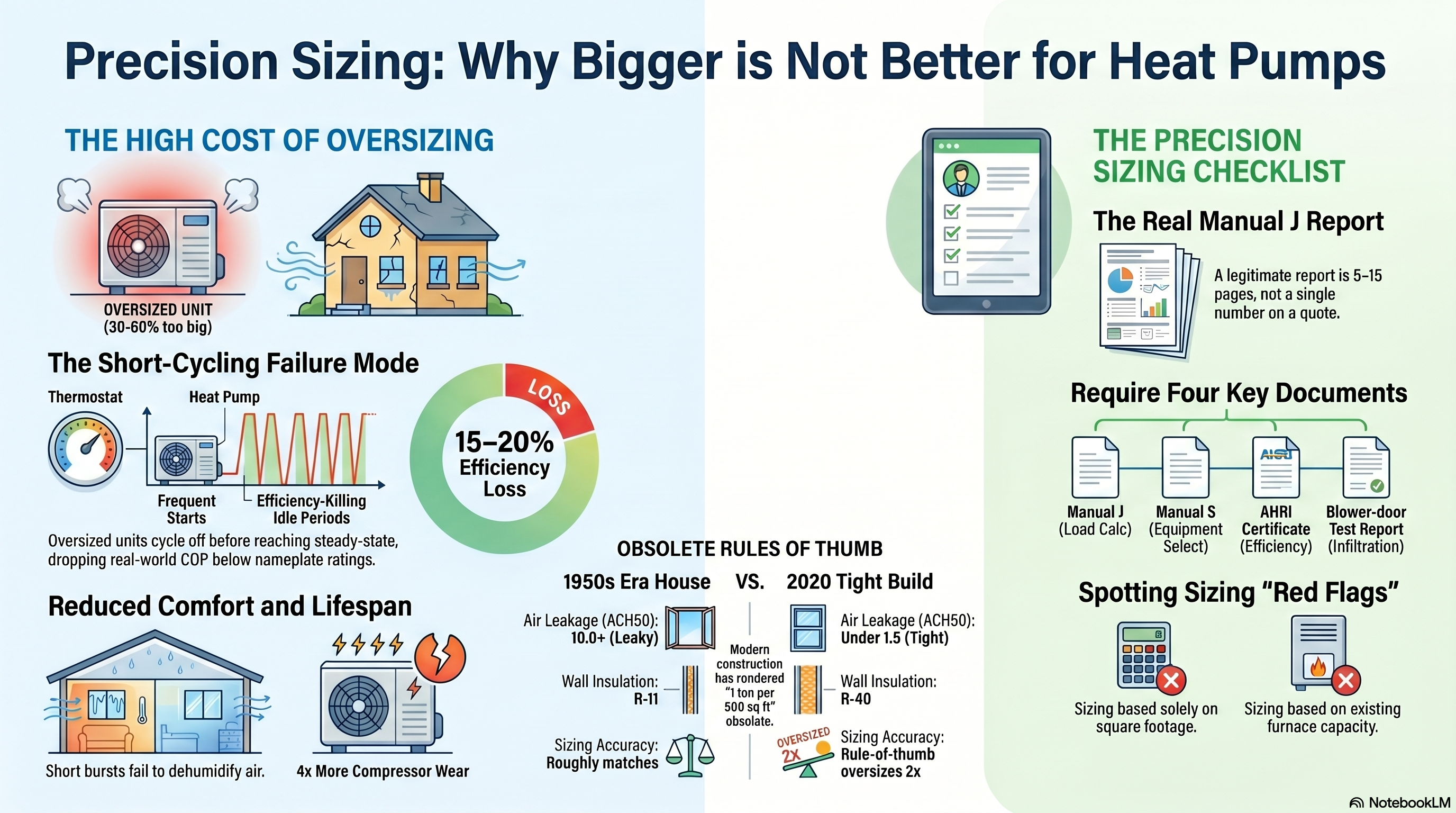
The single largest avoidable mistake in a heat pump install is buying too much equipment. It's not a close call. Industry field studies have shown oversizing rates of 30–60% in residential HVAC for years, and the failure mode is the same in every case: the unit reaches setpoint too fast, shuts off, sits idle while the house drifts, then kicks back on a few minutes later. That's called short-cycling, and it produces every symptom homeowners blame on the heat pump itself — uneven temperatures, clammy air in summer, noisy startups, premature compressor wear. The fix is upstream of the install: a real Manual J load calculation, signed by the contractor, that the homeowner reads before approving the equipment. This post explains what Manual J actually does, what a real one looks like, why rule-of-thumb sizing fails on modern tight homes, and the four documents to require from every quote.
The case against oversizing, in three failure modes
First, comfort. An oversized heat pump in cooling mode runs in short bursts. Each burst drops the air temperature quickly, but the system doesn't run long enough to pull meaningful moisture out of the air — dehumidification is a function of runtime, not capacity, because moisture has to physically condense on the coil and that takes time. Homeowners with oversized cooling routinely report that their house "feels clammy at 72°F" while a right-sized neighbor is comfortable at 76°F. That's the dehumidification gap.
Second, equipment life. Compressors hate starts. The first 30 seconds of a compressor cycle are the highest-wear period — refrigerant pressures equalize, lubricant migrates, motor windings see inrush current. A unit that runs in 12-minute cycles all season is doing 4–5x as many starts per year as a unit that runs in 45-minute cycles, and that maps directly to compressor life expectancy. Modern variable-speed equipment is more forgiving than the old single-stage units, but the principle still holds: longer runtimes at lower modulation are healthier than short bursts at full capacity.
Third, efficiency in heating. Heat pump performance is rated at steady-state, which means the heat pump has been running long enough to settle into its design operating curve. Cold-start losses are real — the first few minutes of operation produce less heat per kWh than steady-state operation does. An oversized heat pump in shoulder season may never reach steady-state because it satisfies setpoint before it gets there. Real-world COP on an oversized unit can be 15–20% below the nameplate rating purely from cycling losses. For more on cold-weather performance specifically, see our cold climate heat pumps post.
What Manual J actually calculates
Manual J is the ACCA (Air Conditioning Contractors of America) procedure for residential load calculations. It is the industry standard, referenced by every major code body and required for permit issuance in most U.S. jurisdictions. What it does, simplified: take the house's envelope (walls, ceilings, floors, windows, doors), assign R-values to each component, multiply each component's U-value by its area and by the temperature difference between indoor setpoint and outdoor design temperature, sum the results, then add infiltration losses (driven by blower-door-measured air leakage), occupant loads, and internal heat gains from appliances and lighting. The output is two numbers: design heat loss (BTU/h) at the local 99% winter design temperature, and design heat gain (BTU/h) at the 1% summer design temperature. Those two numbers are what the heat pump must meet.
The reason this matters more for heat pumps than for old furnaces is that heat pumps have a balance point: as outdoor temperature drops, capacity drops too. A correctly-sized heat pump in a cold climate is sized to its cooling load on the hottest summer day, and then a capacity check is run at the winter design temperature to see how much auxiliary heat (or how much oversizing margin) is needed. Sizing to the heating load — the way furnaces are sized — produces a wildly oversized unit in summer. Manual J runs both calculations and lets the installer see the gap.
Manual J, S, D, T: the four-part series most installers shortcut
ACCA publishes a sequence of four design manuals that, taken together, define a properly-engineered residential HVAC install. Manual J is the load calculation (what the house needs). Manual S is the equipment selection (which specific make/model matches the Manual J output, including the AHRI-listed capacity at your local design temperatures, not just the nameplate tonnage). Manual D is the duct design (how to deliver the conditioned air through ductwork sized for the new equipment's airflow — often the missing step when retrofitting heat pumps into furnace ductwork). Manual T is the register layout (where to place supply and return grilles).
A complete design package will include all four. In practice, most residential contractors stop at Manual J — sometimes — and skip the rest. That's where new-equipment-in-old-ductwork problems originate: the unit is correctly sized, but the ducts are undersized for the airflow it needs, so it runs at high static pressure, makes more noise, and underperforms. If you're replacing equipment without changing ductwork, ask explicitly whether the existing ducts have been validated for the new airflow. If you're changing both, ask for Manual D output as well as Manual J.
What a real Manual J looks like on paper
A finished Manual J is not one number. It's a 5–15 page report (depending on home size) produced by ACCA-approved software — Wrightsoft Right-Suite, Cool Calc, or Elite RHVAC are the three you'll see most often. Real-Manual-J reports have, at minimum:
Project inputs page. The home address, the design temperatures used (e.g., "Outdoor design: 7°F winter, 91°F summer"), the indoor setpoints (typically 70°F heating, 75°F cooling), and the construction details: wall R-value, ceiling R-value, floor R-value, window U-value and SHGC by orientation, door specs, slab edge insulation, ACH50 from a blower-door test, and orientation of the house.
Room-by-room load table. Every conditioned room listed individually, with sensible heating BTU/h, sensible cooling BTU/h, and latent cooling BTU/h for each. This is the part most useful to homeowners — you can see which rooms drive load and whether the contractor accounted for the master bedroom's three west-facing windows or the bonus room over the garage.
Whole-house summary. Total design heating load, total design cooling load (sensible and latent split), and design CFM at the indoor unit. This is the number that drives equipment selection.
Infiltration calculation. Either a measured value from a blower-door test (best), an ACH50 estimate from a similar-vintage home, or a code-default for the construction year. The lower the infiltration, the smaller the load — and modern tight homes (ACH50 under 3.0) have 30–40% lower loads than ACCA defaults assume. Contractors who skip this step typically default to "average" infiltration and routinely oversize tight homes.
If the "Manual J" you're handed is one number on a single line of a quote — or worse, a hand-written tonnage figure — it's not a Manual J. It's a guess wearing the name.
Why rule-of-thumb sizing fails on modern homes
The two rules of thumb most often quoted are "1 ton per 500 sq ft" and "25 BTU/h per sq ft." Both were calibrated to mid-20th-century housing stock — single-pane windows, R-11 wall insulation, ACH50 readings north of 10, no air sealing to speak of. Apply them to a 2010-vintage home (R-21 walls, double-pane low-E windows, ACH50 of 4) and you'll oversize by 30–50%. Apply them to a 2020 Passive-House-adjacent build (R-40 walls, triple-pane, ACH50 below 1.5) and you'll oversize by a factor of two or more.
The reverse is also true. A 1920s home with original windows, balloon-frame walls, and uninsulated rim joists will have a load higher than rule-of-thumb predicts. The point isn't that rules of thumb always oversize — it's that they ignore the envelope, which is the variable that matters most. For any home built in the last 40 years that has had any envelope work done, rule-of-thumb sizing is wrong, and the direction it's wrong is almost always "too big."
The four documents to require from every quote
When you're collecting heat pump quotes, four documents separate the contractors you can trust from the ones you can't. Make these non-negotiable on every quote:
1. The Manual J PDF. Not "we did a Manual J" — the actual report. Read the inputs page. Check that the design temperatures match your climate (NOAA publishes 99% and 1% design temps by station; your local code official also knows). Check that the construction details match your house — if your contractor entered R-13 walls when you have R-21, the load is wrong. Check the room-by-room table for completeness.
2. The Manual S equipment selection. A worksheet or short report showing the AHRI-certified capacity of the selected indoor + outdoor unit pair at your local design conditions, not at the AHRI rating point. Heat pumps in particular have published capacity-at-temperature curves; you want to see the unit's heating capacity at 17°F and at 5°F (or your local design temp), not the rated capacity at 47°F.
3. The AHRI Certificate. A matched-system certificate from the AHRI Directory (ahridirectory.org) showing the indoor unit, outdoor unit, and any specified accessory are tested together as a system. Some federal and state incentives require this; lenders sometimes do; you want it regardless. Without it you have no proof that the equipment combination actually meets the efficiency ratings on the quote.
4. The blower-door test report, if available. Not every contractor will run one and not every home needs one, but if your home has had air sealing work done or you have any reason to believe infiltration is below ACCA defaults, a $300–$500 blower-door test from a third-party energy auditor can be the highest-ROI input to the Manual J. A measured ACH50 of 2.5 on a home the contractor assumed was 7.0 routinely shifts equipment sizing down by half a ton, which is real money and real comfort.
Red flags in a sizing conversation
A few patterns to watch for in quote conversations:
"I'll match your existing furnace size." If your existing furnace is oversized — and most are — this propagates the error. Furnace sizing has historically been even more aggressive than AC sizing because gas was cheap and the failure mode of an oversized furnace was less obvious.
"You don't need a Manual J, I've been doing this 30 years." Sometimes true, but never verifiable without the document. A real Manual J takes 1–2 hours of software work for an experienced installer; it's not a meaningful cost barrier. Refusal to produce one is the signal.
Sizing based on square footage alone. Heard "your house is 2,000 sq ft, you need a 4-ton"? That's rule-of-thumb sizing rebranded. Two 2,000 sq ft homes with different envelopes will have loads differing by 30%+; the conversation should be about envelope, not just floor area.
No discussion of dehumidification or latent load. In humid climates (anything east of the Mississippi, plus the Gulf Coast and the Pacific Northwest summer), latent load is a separate calculation from sensible load. Oversizing on the sensible side specifically worsens dehumidification. A contractor who hasn't mentioned latent load probably hasn't run one.
For variable-speed heat pumps: the modulation argument
One nuance worth knowing: modern variable-speed (inverter-driven) heat pumps modulate capacity continuously, sometimes from as low as 20% of nameplate up to 130%. They tolerate oversizing better than single-stage equipment because at part-load they can throttle down rather than cycle off. That has led some contractors to argue oversizing is no longer a concern with variable-speed gear.
The argument is half-right. Variable-speed equipment does tolerate moderate oversizing — say, 20% above design — without serious short-cycling penalties. But significant oversizing (40%+) overruns the modulation range; the unit hits its minimum capacity and starts cycling even with variable-speed control. And the dehumidification gap doesn't go away: minimum modulation airflow can be too high relative to the home's sensible load, so the coil never gets cold enough for long enough to dehumidify well. The right framing is that variable-speed equipment gives you a wider margin of error, not a license to skip the load calc.
What to do next
Three steps before you sign anything. Get the Manual J in writing from at least two contractors and compare them — if they disagree by more than 15%, dig into the inputs page to find out where. Check the AHRI certificate and ENERGY STAR certified-product entry for the specific equipment combination on your quote. And run the proposed sizing past one independent check: ACCA's ManualJ.com online estimator and Cool Calc's free homeowner tool both produce rough load estimates from envelope inputs and are useful sanity checks against a contractor's number. If you're still calibrating on cost first, the cost pages show what right-sized installs typically run by metro, and the rebates index shows what's available to offset it. The credit math is meaningful, but the install math starts with sizing — and that's where most of the long-term cost of the system gets decided.